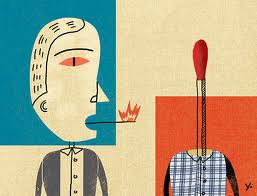
The Great Lie.

One of the great lies of mental illness is that, “If things weren’t so stressful, I wouldn’t feel so bad.”  Look inside ourselves now and see them.  All the numbered and ranked stressors we tick off to explain how we feel and/or behave.  How about someone we love.  Do we tell them, “Of course you feel that way!  Look at all you’re going through!”

Because major depressive disorder (MDD) is mainstream enough, I’ll use it as an example.  Who, when they are down, doesn’t look for reasons why?  Say there is an additive effect of stressors such as home conflicts, financial duress, and poor sleep.  Since these events, you haven’t felt pleasure, you’ve felt sad and depressed.  You aren’t motivated or interested in your usual.  And where you normally would seek people out when you felt down, to get more energy, now you just want to be alone.  And so on.  You are able to say that you started feeling this way progressively since triggered with those stressors about 3 months-ago.  Before that you were “fine.”

Many people in your life, have told you that you are just going through a bad spell.  You have believed them but say, “Even if this is a bad spell, if it goes on much longer I think I’d rather die.”  Your best friend responds, “Anyone would be depressed if their boss was that evil!”

My answer, “No.”  Feeling down is appropriate to stress when it doesn’t disrupt your life for more than two weeks at this level.  And it is never normal to want to die.  Everyone has stress but not everyone responds to stress in the same way.  Not everyone if put under your same triggers would develop MDD.

Would you have developed this disease if you weren’t put under these stressors?  I can’t say.  We develop illnesses for many reasons.  One of the many reasons is external stress.  A hypothesis supporting this is that stressors trigger our genes for MDD much like we know cancer genes can be turned on by stress.  However, we do not have a direct correlation to the stressors as being entirely causal events.

Even if it were, none-the-less, we are left with the disease process in progress.  It is not an adjustment reaction to stress.  It is medical illness.

Feeling this way is not normal for what you are going through.  Telling yourself that it is, that is the great lie.

Self-Care Tip #118 – Don’t believe the lie if what you’re going through is affecting your function in life.  Be a friend to yourself.

Question:  What whispering lies are you struggling against?  Please tell me your story.

Pebbles to Diamonds


yourloosediamonds.com

Self-Care Tip #117 – Notice, you got diamonds out of stones!  Be a friend to yourself.

Cindy replied to yesterday’s post (that had some discussion on functional mental illness,) “I understand Miranda’s feelings completely.  Some days it’s all I can do not to down tools and scream ‘What about ME?’”

That is one of the lovelies that these illnesses bring to us.  In our honest moments, we can, like Cindy did, perceive our own traits that resemble them.  Perhaps, if we are lucky, that will lead to empathy, one of the great human experiences.  To be able to put yourself in the hypothetical place of someone else.  To imagine what they think and feel.  “If I were in your shoes…” and so forth.  If you’d like, read more on this at this post.

Illness is often considered a step in the dyeing process.  Others see it as part of the living process.  Of course, it is both.  We are all on level ground when it comes to having been born, coming into life, and knowing we will equally die.  Illness reminds us of our like-natured frailty and of course the opposite – resilience.  Whether seeing our own illness or someone else’s, we have this privilege of being blessed this way.

My Dad used to tell me a story (author unknown) when I was little.  It’s been a long time but I remember it this way.

Three travelers were walking when they heard a voice telling them to bend down, pick up pebbles and put them in their pockets.  The voice told them further that in the morning they would be both happy and sad.  The travelers did but not equally.  Some pockets were more full than others.  In the morning when they awoke, their stones had turned to diamonds.  Whoever gathered many stones were happy even though all of them wished they picked up more stones.  But whoever gathered few, well, they were not happy.  They still had diamonds but the comparison soured them and they finished their journey full of “what if” thoughts and not thoughts about the obvious.  They got diamonds out of stones!

We are all similar, with the opportunity to say thanks in seemingly off times, such as mental illness.

Question:  What have your “stones” turned into?  Please tell me your story.

Who Cares What Your Diagnosis Is?

Wheelchair basketball at the 2008 Summer Paral...

Image via Wikipedia

Self-Care Tip #115 – If it’s not serving you well, don’t waste your time on it.  Be a friend to yourself.

Trixie Hidalgo, advocate to end violence in America, tells me that many of the people engaging in gang crimes tell her that they are put in their life positions (poor, stereotyped, impoverished) by the people who have the power, to keep those people in power and to keep them down.  They have some credible arguments we’ve shared before in history relating to oppression such as race, color, gender, money, or status.  Are these people victims?  Sure, why not.  But is that the point here?

The victims reminded me of a clinic I was in the other day.  I was working with Marcus and his father.  The father was torn about where to go to get his disabled son, Marcus, treatment.  Marcus was disabled with both brain illnesses and severe psychosocial stressors.  Currently we found Marcus, 2 years into treatment with me, and as of yet, father and mother (divorced without amicable terms) had yet to engage in treatment with me.  They wanted to know why Marcus was the way he was.  Father pointed at Mother and Mother pointed at Father.  They blamed other things as well, the schools not providing the right services, the medications for not working, his genes, and more.  Meanwhile, Marcus is tearing up his classroom and his own life.  He is barely functional socially.  Moody and volatile.  Anxious with physical symptoms.  He was having multiple medical work-ups going successively for various physical complaints.

Before I let them go, I told his parents, “Who cares what his diagnoses are?  It’s not about the diagnosis.”  The purpose of a diagnosis is to serve the patient.  The patient doesn’t serve the diagnosis.  Right now, Marcus was serving the quest for his diagnoses.  If all they can see is that, and they miss the fact that their son isn’t functioning, he’s depressed and anxious and violent and no one can stand to be around him, Marcus is worsening continually while they go on debating – they’ve missed “IT.”

They’ve missed it.  And so have we when we waste time counting up the offenses we’ve directly or indirectly suffered.  We miss it when we increase our injury by holding ourselves responsible to our history.  I asked Marcus’ parents what the point of what they were doing for Marcus was.  I ask the victims of America, what the point is when they point to history to answer for their present condition.  If it’s not serving you well, if it’s not doing something good for you, than what are you doing with it?  Do good things for yourself.

For the victims, for Marcus, and for Marcus’ parents, 1st make sure we weren’t missing something medical that was keeping them from having life quality.  You can’t give what you don’t have.  Then move on to the psychosocial issues and spiritual and so on.  What ever we ran into that missed our point, we’d walk past it together and on to something that served us well.

If you’d like to read more on this topic, read more in “It’s Time to Grow Up” and “The Whole World Becomes Blind.”

Question:  How have you managed to move past things that weren’t serving you well?  Please tell me your story.

Blog Carnival – psyche’s flashlight

Blog Carnival – psyche’s flashlight.

Looking the monster in the face, and/or discovering that it’s a god.

Description ¤ Dedicated to the personal experience of mental illness, psychiatry, psychology, and mental health, especially from the point of view of the patient, client, consumer, sufferer. Open also to health care providers, mental health professionals, friends and family, academics, writers, researchers, and anyone else who blogs about this subject.
Keywords ¤ mental illness, psychiatry, psychology, mental health, patient, client, consumer, sufferer, health care providers, mental health professionals
Filed under ¤ medicine, health & fitness
Carnival homepage ¤ High School Confidential
Submission deadline ¤ last Saturday of every month by 9pm EDT
Maintained by ¤ Bor D. Erline
Current status ¤ This carnival is ongoing.

Regardless The Reasons Not To, Go Get Your Sleep

Newborn child, seconds after birth. The umbili...

Image via Wikipedia

Self-Care # 113 – Regardless of the reasons not to, go get your sleep.  Be a friend to yourself.

I was speaking with Sheri about her sleep problems, and we aired some of the fears that she hadn’t realized influenced her related choices.

Here’s her current scenario.  She is a survivor of multiple trauma’s involving her children.  Currently only 2 of her 7 member household sleep through the night.  It’s been years since the rest of them did.

Sheri said,

I can’t just let them cry (speaking about her 8 month old infant and toddler.)  That’s child abuse.

Now this is a smart, well-read woman.  She’s read “Baby Whisperer,” “Babywise,” “Dr. Spock,” and just about every other parenting book out there.  She believes her intuition however and her intuition tells her that if baby cries, baby needs her.

Sheri tells me,

On a good night, when I am woken up only 6 times or less, I feel much better the next day.

(Um, did anyone else notice what she said?  A good night.  Ok.)

Sheri says when she sleeps “well,” her thoughts are clearer, her mood is more positive, she is a more effective parent and wife.  Sheri is telling me what I tell others.  However information and knowledge are not always enough.

Sheri knows she needs more sleep but she feels trapped between what she knows in her mind and what her gut tells her.

Question for Sheri:  When you get up to soothe the babies, are you doing it more for you or for them?  I got no direct answer to that question and let it rest.

Suggestions for Sheri and any other listening parents stuck between their mind and their intuition:

1.  Clean out the spare room and put 2 small beds in there.  Nothing else in the room.  (Remember sleep hygiene.  The bedroom is only for sleep and for sex and if you aren’t having sex, all you get to do is sleep.  Sounds silly when in context of babies?  This is however true.  Regardless of your age.)

2.  Put a fan outside the closed door to the baby’s room.

3.  If you hear the baby crying, get up and help.  If you don’t, than sleep, and baby can teach themselves to fall back to sleep without your help.

If you don’t do this already reader in your own bedroom, don’t feel too bad.  I remember giving a lecture to a room full of physicians and asked them, “Who had their bedroom set up this way?”  Not one of them raised their hands.

Changing our bedrooms to be appropriate for good sleep hygiene is a cultural change for the family.  It moves activity out of the bedroom obviously and into the home’s community space.  Everyone has to renegotiate that space.  A personal hide-out can be harder to find.

But it works!  Just Google “sleep hygiene” and you’ll read oodles on this.  You don’t have to believe me.

I’ve worked with disabled kids even, who have a ton of biological reasons not to be able to sleep through the night.  However, many of them did once their parents helped them with their sleep hygiene.  This method can crack some of the hardest cases of insomnia.  If these kids can do it, we can too.

If you can’t easily get into the groove of good sleep hygiene, you are not alone.  Keep trying.  It will be worth it.

Question:  What are your barriers to getting good sleep?  Or, what has helped you do whatever it takes to get your sleep?  Has either choice been worth it to you?  Please tell me your story.

Stay Connected For Your Sake and For Theirs

Members of Bound4LIFE in Washington, D.C. symb...

Image via Wikipedia

Self-Care Tip – Stay connected for your sake and for theirs.

We have all seen “kids” who stop talking.  Driving by, their faces in the car window a little strained, their bodies postured away, maybe their hand fisted under their chin.  Their parents lost their chance.  Whatever they now want their kids to do, they’ve lost more than their authority.  As have the kids.  The kids lose out on having their parents voice in their lives.

It is the same with us in the world.  When the world stops speaking to us, we lose our influence.  When we stop speaking to the world, the world stops listening.  We loose our voice.  People won’t listen when we want them to.

Some of us may not be in that place now, but there will come a day when we want the world to care what we say.  I’m not talking just about leaving a legacy, or having people care about what we’re going through when we are in crisis.  This includes all the other times of life.  The in-process times.

When we are angry at whoever graffitied our neighborhood.  When we survive prejudice.  When we share our child with the world.  We want to have a voice.

And if we stop speaking, we will lose.  If we don’t respect the opportunity to connect, if we don’t treat it as the treasure that it is, not only will the world miss out on the “Me,” we miss out on the world at large.  It goes both ways.

We have a choice.  Get friendly with yourself.  Speak.  Listen.  Connect.

Question:  When have you wanted to be heard?  How does it affect your life to be connected?  Please tell me your story.


Grieve to Be Present With Yourself


Maria Yakunchikova "Fear" 1893-95

Image via Wikipedia


We grieve when we get sick.  And we grieve again when after getting well, we get sick again.  Then the grieving can be even more terrible because you know what’s coming.  In Pearla’s case, she didn’t know she was grieving but she knew she was sad and terrified at the same time.

I asked her if she thought that staying in bed, loosing interest, isolating, crying jags out of the blue might be related her grief about getting sick again.  She said no at first and then said, “I’m disappointed.  I thought this was over for me.”  All over, she couldn’t trust herself.

Pearla was afraid. And that fear was always there.  Now she couldn’t put it out of her mind.  “What if I have another panic attack?  I can’t take it!”  “What if,” was always on her mind.

Readers, a panic attack is more terrifying than just about any immediate experience.  If you’ve never had one, it is almost impossible to imagine the depth of terror it causes.  It is so horrible, that people even change professions because of it.  I remember a surgeon who actually went back to residency and studied a new specialty because he linked his panic to his profession.  That’s another 4 years of grueling work, readers.  That’s the kind of fear panic produces.

Pearla was not only in the throes of this fear, she was also in the throes of grief.  This is a deep sadness any of us who have lost a beloved hope can relate to.  Pearla didn’t know that was why she didn’t want to get out of bed.  All she knew is over the last 2 weeks she was loosing herself and in exchange, getting something she desperately did not want.

Somehow though, after hearing about her sadness from her own mouth, Pearla agreed.  She saw the grief and after seeing grief, she could be more present with it.  It was almost like her face materially came out from hiding.  Grief lost some hold on her.  She was a little less sad and a little less afraid.

Self-Care Tip #111 – Let yourself grieve.  Be a friend to yourself.

Question:  How do you grieve?  Was it worth it to you?  Please tell me your story.

Wearing A Bit Of Disguise For The Sake of Being Open

Self-Care Tip #110 – Find your masquerade and let it teach you how to be open.

We often talk about taking masks off.  About being open and “face” our lives with courage.  However doing that isn’t always as easy as saying it.  Sometimes doing the opposite makes it easier in preparation for when we have courage to try again.  Sometimes putting the mask on makes it easier to more completely know and be known.

On Twitter today, this came from bigfishtopdogs Theresa BradleyBanta:

Here’s my #FF. These people rock! They engage!
And there was my name.
I wondered why we can say these high-fivers so spontaneously on Twitter from people we know only a few pixels deep.  I “met” Theresa BradleyBanta on her blog site bigfishtopdogs.com only a few days ago and she’s already telling people that I “rock!”  It is so cool!  (Just as an aside, she rocks too.  Her site is all about coaching and mentoring on entrepreneurial endeavors.)

Getting that fresh compliment almost stung when I realized how I preened underneath it.  Here in the real world, I don’t know who to show my feathers to.  My reply to Theresa was

Wow. How come I can’t hear anyone say that in “real life?”.  Twitter is like a smokey dark room where anything can happen.

Sometimes people think of hiding behind things as a way to do indiscrete lascivious acts that you wouldn’t want to do if you were identified.

I propose that a little hiding is a good thing for ourselves.  To get up close and personal.  To share over-the-top compliments and receive them.  It doesn’t mean something bad unless we use it badly.  I propose that when we disguise a little on occasion, we might remember how to act more freely when we are in the open – how to, when we try again.

Having the courage to try again and again to connect gets easier when we have fun reminders as to why we want it so bad.

Question:  What have your positive experiences been when you were a little less inhibited?  If fantasies could come true, how would you like it to carry over into your “real” life?  Please tell me your story.


Branding and Branded. Stigma Goes Both Ways.


mentalhealth.wa.gov.au


Oh, the struggle to understand that behaviors may have something to do with the brain! I shake my fist at stigma! I shake my fist at prejudice!

Now, I can go on a little calmer and say, if you are struggling with this yourself, you are not alone. Even if you are the one propagating it. You stand on the shoulders of others.

In Jesus’ own words:

Father, forgive them for they know not what they do.

He was talking to me, I know, and you.   We have all been rude and ignorant in our own time and our own place.   We find ourselves holding 2 positions, accuser and accused. The context of our various roles changes with knowledge, coping skills, experience, maturity, pain, mental capacity and so on.   But that we hold both roles in some space of time and place will never change in this world.   Even in heaven when we “see face-to-face” we won’t be completely informed.  We know we will continue learning timelessly. What will change is the abuse, the prejudice, the judgement.  Once and for all, we will finally let that go and believe at a chromosomal level that God is and deserves to be the only Judge.

There must be a genetic component to our double lives in this world. This tendency towards stigmatizing. We know there is a lot that isn’t genetic and for that we fight to grow ourselves and grow others for our own sakes and for theirs. The benefits reciprocate as much as the pain does. And even though being branded feels personal, it is not.

For more relating to this, read the blog posts Forget About Divisions In Knowledge, and Forgive to Get Friendly With Yourself.

Self-Care Tip #109 – Don’t take it too personally when people sneer. Be a friend to yourself.

Question: How do you keep yourself objective when prejudice hits you or someone you love? Please tell me your story.

When Suicide Almost Made Sense

Hello world. Please comment.

nancy says:
November 17, 2010 at 8:01 am (Edit)
I could write a book….but suffice it to say, to the day she died, my mother never even told her best friend that I had had a breakdown and was on medication, my sister said I couldn’t possibly be a Christian and be mentally ill, people at church have told me that they actually walked across pews to avoid talking with me when I was sick, and, even though I’m off all medications but Klonopin and seeing a therapist only every three or four months “just to keep in touch”, I can’t go anywhere or meet anyone new without feeling as if I’m wearing a sign saying “Mentally Ill” around my neck. My attitude about people with emotional problems? God bless them…and I pray that they have a really good connection with HIm. It (and the love of my family) is the only thing that kept me alive.

Question: aside from the obvious nausea and anger that stigma and prejudice bring on, what do you have to say? Please tell me your story.

When It Is Time To Take Medication

"Yard with Lunatics"

Image via Wikipedia

When is it time to use medications for mental illness?

It is time to consider a medical cause for your behavior and mood when:

1.  you can no longer control them

2.  they affect the various areas of your life

3.  you start having other physical symptoms not accounted for through medical exam and studies, such as:

  • sleep changes (Pearl:  Sleep is known as the vital sign in psychiatry.)
  • change in energy
  • gastrointestinal – stomach upset, nausea/vomiting/diarrhea, change in appetite
  • neurological – headache, numbness, tingling, shaking, change in response time physically or verbally

I’m sure I missed a few things, but roughly, these are guidelines that can apply to most mental illnesses on multiple spectrums, such as anxiety, mood, psychosis, addictions, and even character pathology.

According the numbers count done by NIMH:

…about one in four adults — suffer from a diagnosable mental disorder in a given year. When applied to the 2004 U.S. Census residential population estimate for ages 18 and older, this figure translates to 57.7 million people.  …mental disorders are the leading cause of disability in the U.S. and Canada.

When you next go outside and walk in a crowd, count them.  One, two, three, mental illness.  One, two, three, mental illness.  And so on….  If you suffer from mental illness, you are not alone.

If you buy any of this, if you see these things in yourself, consider seeing a physician for further evaluation and possible medical care.

Self-Care Tip #108 – Take medication if it’s medical.  Be a friend to yourself.

Question:  How has your definition of mental illness affected your ability to get treatment?  Or how has it affected your interaction with those who are in treatment?  Please tell me your story.

Related Articles from FriendtoYourself.com
  • Mental Illness Relapses When Medications Are Stopped http://bit.ly/pA4kxo
  • Number One Reason For Relapse In Mental Illness  http://bit.ly/rt1qJf
  • Are Your Meds Safe?  http://bit.ly/lh1cBh
  • Say Yes to Medication And No To Drugs  http://bit.ly/oX12i0
  • Fears of Addiction To Medications for Brain Illness http://bit.ly/oWY8i4
  • Other Fears of Medication For Brain Illness  http://bit.ly/qdHksR
  • Afraid of Meds  http://bit.ly/rjt7wY
  • Full Treatment Response Means a Better Future  http://bit.ly/ph84ZU

Listen To The Intention In What People Say

Self-Care Tip #107 – Listen to the intention in what other people say.  Be a friend to yourself.

Knowing when to stand up.  To speak out.  There’s so much said about letting things go that when we don’t, we can feel, if not see, the people pinching up inside.  “Uck!”  But that can’t always be good, keeping quiet.

Trying to connect is hard to do in silence.  It’s hard to do in sound too, if it doesn’t penetrate.  Connections are penetrating experiences.  They get inside and hook us.  They touch our simple selves and although foreign, don’t corrupt us.  That is the Love’s job – the cleanness of it.  We are touched but still clean because of Love.  Without it, getting touched can feel contaminating, dirty.

In an earlier blog post, “Criticize if You Love Me,” I spoke about the love it takes to deal with a problem, and not walk away.  The comments made the post bigger and better by highlighting how much courage it takes not only to give criticism, but also to receive it.  And more often, I was told about the pain people received from criticism.

There are 2 parts here.  The “Giver” and the “Taker.”  Giving criticism can be more about the person giving it than anything to do with the person receiving it.  It is in reality often an attempt by Giver to connect.  And when it doesn’t feel that way by Taker, it becomes disconnecting.


tele-smart.com


2 parts, remember?  Which ever side we are on, we have a choice.  We have a choice to connect.  Knowing something of the intention of Giver to connect must help that choice some, even when it doesn’t feel like what they are saying has anything good in it.

The real part of us is sacred.  Any contact to our simple selves is a privilege.  It is a privilege to both parties – Giver and Taker.  Both parties can be blessed and then in that exchange, Giver becomes Taker.

So think about what you want to say to someone you love and give.  Now, think about what you are hearing.  Take it.  And connect.

Question:  Do you find yourself on one side or another?  How do you connect?  Please tell me your story.

It’s Time To Grow Up


Fragile Annie writes a blog called, “It’s Time To Get Over How Fragile You Are.”  Isn’t that a great name?  She own’s her frailty, own’s that it has affected her life, and own’s what it’s time to do now.  All in a name and a title.

When I was in psychotherapy, talking on about injustices suffered, my feelings, the rightness of my condition – my therapist said, “It’s time to grow up Sana.”  I still feel the punch in my stomach and the quiet immediately following.  I couldn’t breath for a bit.  Just nodded my head.  “Ok.”  …I said, “Ok” a few times.  I don’t remember much else of what he told me but I don’t think I’ll ever forget that.  He’d be satisfied with his work with me if he knew.

After all, it’s not such a small thing to grow up, or “get over” our frailty.  It’s not such a small thing to see our need.  It’s not so little to act on it.  These are things that champions do.  These are things any coach, parent, therapist, teacher would be proud to be a part of.  These are the things that make the difference between falling victim to your history, or claiming the rights to your now and to your future.

Think about what is upsetting you the most.  What seems to keep at you and trip you and keep you back and keep you right where it left you last?  It’s time to grow up.

Self-Care Tip #106 – In Fragile Annie’s own words, “It’s time to get over how fragile you are.”  Be a friend to yourself.

Question:  What has knocked your breath out in a good way, sending you off towards growth?  Please tell me your story.

Growing Up Is Not Necessarily The Same as Growing Away


cant decide so dance

Image by faster panda kill kill via Flickr


Self-Care Tip #105 – Grow up, think on your own, and stay connected.  Be a friend to yourself.

Staying connected doesn’t mean loosing your freedom.  Staying connected doesn’t mean immaturity.  And independent thought doesn’t mean disconnecting from others or your foundation in life.

When we move into adulthood, we move into roles requiring responsibility, autonomous decision-making, teaching like parents.   This is confusing don’t you think when we were designed to be connected?  Well when something feels so wrong inside, listen to it.  There is a incongruence with what you intuitive know.  Independence includes dependence

Adulthood means learning to have creative thought while being willing to learn.  It means disconnecting while remaining connected.  It’s not all-or-none.  It’s seeing the strength in vulnerability.  Part of taking care of “Me” includes choosing dependence.

Dependence never takes away freedom.  Sometimes when I listen to people telling me how I should feel or think, I feel caged and start doing things to make me feel less caged.  Unfortunately sometimes that isn’t a healthy thing, like eating chocolate or… well it’s often eating for some reason.  Other people do this too.  They may cut on themselves or bang their head.  Unnecessary, because we are free no matter.  Drugs.  Whatever it is that in the moment somehow springs you from the phantom cage only to put you in another.

Question:  How do you live free yet connected?  How do you deal with feelings of infancy, immaturity, loosing freedom when it comes?  Please tell me Your story.

Forget About Divisions In Knowledge.

The World Is Flat

Image via Wikipedia

Self-Care Tip #103 – Forget about divisions in knowledge.  Be a friend to yourself.

Knowledge does not separate into parts of religion, diet, stars, or geometry.  It is one thing, although we may not see its entirety.  Like the blind men with the elephant, we might be standing by the foot or the trunk.  But it is one thing.  Spiritual truth, nature, physics, medicine, music, art, it’s the same story told in pieces and in different ways.

Working in psychiatry, I’ve struggled with this because it so often affects my freedom in practice.  It so often affects people’s choices for treatment, people’s choices for lifestyle and their own empowerment with self-care.  It affects the choices people make in medication therapy and in physicians.

Merging the tables of learning affects our quality of life either way.  If we are able to do this, we have less conflict, fewer chairs to walk around.  If we can’t, we find ourselves constantly checking the seating charts.  It’s terrible throwing a party where people don’t know what connects them.  There’s the same discomfort inside of us when our life paradigms are afraid of each other.

Take Crystal.  She is a Latina Catholic.  Or make her protestant Filipina, or say White Texan.  Crystal grew up thinking that what was said by her tias (aunts,) or her pastor, or performed by her grit and spine, lay like bookmarks between human behavior issues and the rest of her life.  Behaviors may have something to do with the church, or emotions with the girls room, or nothing to do with anything in her mind.  Thinking behaviors and emotions might relate to what gave her black hair color, and to why water separates from oil is just bizarre to her.

When, Thomas Friedman wrote The World Is Flat: A Brief History of the Twenty-First Century, he was talking about a leveling of the playing field of commerce.  To take it further, I hear him talking about a flattening of prejudices, knowledge, access to information and hierarchies.  The world is too flat to separate the brain from the rest of the body.  When the world is flat, working as a psychiatrist means enlisting all of science, religion, social issues, hobbies, food preferences, and all the other things that make someone’s life worth living for their treatment.  When the world is flat, a patient trying to get help for their emotional-behavioral illness doesn’t separate it from anything else in their journey.

It turns out that we have a lot of information on where emotions and behaviors come from.  We should use it, don’t you think?

Of course, we don’t have it all.  Not close.  We don’t know how the soul factors in.  We don’t know what miracles are.  We don’t know God face to face.  But we do know that it is the same table of knowledge.  It is the same elephant in the room.  It all comes from the same Love.

Walk around.  Feel around.  Let your quality of life get better.  Don’t cut yourself off from another part of you if you don’t have to.

Question:  How are you keeping your personal journey one that is connected?  Or not?  Please tell me your story.

Your Life. Your Choice. Why Are You Still Negotiating?


Self-Care Tip #102 – Take what is yours and live.  Be a friend to yourself.

Cheri came, still dressed in work scrubs, with her 2 daughters, 8 years old and 3 years old.  Having finished their dinner date, they were swinging by for her appointment before going home.  Cheri told her kids, “Get out now and go sit in the lobby!  If you don’t listen to me I’ll….”  Turning to me, she said, “It’s never enough!  I just took them to dinner and they do this to me!  No matter what I do…!”

1.  Cheri tells me she’d like to cope better with simple stressors such as redirecting her kids

2.  We talk at length about her perception of her kids abusing her.

Cheri is married.  Her husband laughs at her for “…having to take those drugs to be normal!”  “…But he just sleeps his problems away.  He doesn’t deal with them like I do.  He has no idea!”

3.  We talk more about her perception that her husband is responsible for her place in life.

Cheri believes if she doesn’t take more than 2 pills a day, she is less “dependent” on drugs.  She says, “I don’t want to go on like this!”  Her tears continue talking when her voice stops.  She is ashamed.

4.  The concepts supporting taking care of yourself as being the kick-off point to caring for anyone else comes up.

5.  We talk some more about who is “The Why” for what we do or don’t do.

Cheri feels less shame, but it’s still there.  She is willing to give a new medication a try but clearly doesn’t buy it all yet.  She’s going home with her girls to her husband with new pills.  And hope?  Yes.  It is all connected.  It all pulses together and is a living negotiation of sorts.

Disease <–> behavioral/emotional negative symptoms <–> victim role <–> self-neglect <–> greater crisis <–> seeking help <–> responsible self-care <–>  healing <–> fewer behavioral/emotional negative symptoms <–> emotional abuse from husband may continue but is no longer seen as responsible for personal choices and self-care <–> less shame <–> further healing and so on….  (Lub-dub…Lub-dub…)


hbofamily.com


Cheri is still negotiating her deal in life.  She doesn’t realize that it’s already hers for the taking.  Her life.  Her choice.

The deal is already made.  Take it or leave it.  Your life to live.

Question:  How are your negotiations?  Do you see them as still in progress or settled.  Please tell me your story.

Don’t Waste Your Time. Do Your Thing.

[en] teacher, profesor, educator, school pt pr...

Image via Wikipedia

Self-Care Tip #101 – Don’t waste your time if you don’t have to on things you aren’t good at.

Ben is almost 16 years old.  His parents are happy because he’s not as depressed, more interactive and more interested in connecting with others.  They came with him to see me.  Ben gets easily overwhelmed trying to tell me about himself and his parents often interject to help him out.

Ben’s parents are parents to admire.  Patient and clear-sighted regarding values and presence.  I’ve caught my breath more than once in the company of their comfortable regard and affection for their disabled children.  (Ben’s sister also suffers from mental retardation.)

During clinic, Ben struggled to tell me he was bothered and stressed by the school staff pressing him to learn things he didn’t care about.  He lost his words over the bits about how it related to his self-esteem and looked at him mom.

Mom told me Ben doesn’t care about some of the topics he’s taught and he gets sad and anxious when he thinks about it.  He’s embarrassed by it because he doesn’t finish as quickly as others and misses some of his lunch time.

I’m not a high school educator but I still told Mom and Dad that they can feel more confident advocating for Ben’s interests and needs with his teachers.  Ben will excel more in areas he is interested in.  He will find more pleasure in them.  He will be more empowered emotionally.  He will  be more ready for his adulthood needs.

The pressure many of us grew up with to be good at everything, is bogus.  We shouldn’t.  What we should do, is be good at what we are talented at.  We should be good at what we are interested in.  In fact, be shameless about it.  I spoke about this in the post “Do What You Were Designed to Do,” amongst others if you want to read more.

Ben with his parents looked at me with something of relief.  They had “permission” to do what they wanted.  The rest is mostly a waste of time.

Question:  What has opened you up to doing what you want to do in life?  What has that done for you?  Please tell me your story.

It’s Not All Good


soundtrackcentral.blogspot.com


Self-Care Tip # 100 – Don’t forget what you know to be true, when other people don’t keep up with your learning curve.

You have finally started to understand that You take care of you.  You bought into that when you do, you can do more of what you want to do for others.  You believe that the responsibility to be healthy in mind and body starts and ends with the “Me.”  Isn’t that wonderful?  Yes.  Don’t forget it when other people don’t keep up.

Cynthia was on a self-awareness high.  She saw through open eyes her neglected self.  She was astounded looking at her thrashing person giving her last bit of stuff to the jobs she infrequently satisfied.  Instead of feeling defeated, however, she now felt empowered.  She was so ready!

It went well for a time.  Her husband noticed, approved, commended, and encouraged her.  They talked about it.  Her kids, reluctantly let go of her legs so she could leave to exercise.  At work, she personalized less and was not as interested in office politics – contented to do her own job.  Then it slowly started.  People started resenting her for it.  Her peers starting making jabs.  The kids would climax and tantrum just as she was about to leave to exercise.  But what really surprised her, and not in a good way, was when her husband got upset.  Not a lot.  But enough that the guilt she had talked down seized the opportunity to multiply.  It was like gremlins.  When the guilt gets wetted like that, it multiplies!

Doing what is right is not always celebrated.  Cynthia is working through that now and every day, as it is for you and me, she is finding the courage to get past that.

Question:  What has surprised you good or bad in your journey towards self-care?  What have you needed the most courage for?  Please tell me your story.

Getting Away From All-Or-None Thinking

IMG_1738
Image by DanaMums via Flickr

Self-Care Tip #98 – Getting out of all-or-none thinking may mean getting medical help.

Number five on Bella’s list:

The day has been ruined!” Bella said.  Her eyes sparkled and flashed as she spoke of her injury.  Bella was not so pleased with her labor’s reward.  She was not so satisfied with being accountable for her children‘s behaviors, when they thwarted her every effort at having a good family experience.

A reader eloquently commented what I now want to write on my mirror, about her walk through and away from all-or-none thinking:

..really only part of my day was ruined – the part when I was hurt or angry or frustrated or depressed, etc. – and, even then, only PART of me was totally miserable. I was still able to think about other things, get things done around the house, talk to a family member or friend. It’s really calming to know that I can hurt and still function because there are so many pieces of me and my life that are still okay. Suddenly, everything seems to be easier to deal with.

In an earlier post, “Adequate,” we talked about the truth being in the gray.  As my Dad so often told me,

Things are never as bad as they seem.

I had a hard time believing that at times when I was a kid, and now that I’m old-er 😉 I buy it cognitively but find I often doubt is at an emotionally intuitive level.  However, things do get much much much better for all of us after good sleep, exercise, water, and if medically needed, medication.

All-or-none thinking, extreme thinking, catastrophizing isn’t just about coping skills.  It can also be about our medical condition.  It’s very difficult to modulate emotions when you are emotionally ill.  I’ve heard so many confounded people say that they just couldn’t stop themselves from going into extreme emotions.  They struggled with reactions way past what the experience warranted.

A kid doesn’t listen to words and Dad is kicking a hole in the door.

A couple argues over levels of intimacy and the girl finds herself in the bathroom with a cutting tool.

Work is another day of punitive treatment by an employer with lesser intelligence and she’s vomiting up food.

In these examples, we reflexively coddle the person, saying, “Anyone would be upset if….”  However that is not true entirely.  Enabling someone’s illness is easy to do.  Bad things happen to everyone.  But not everyone responds in a way that is repeatedly unhealthy to themselves.

In order to treat ourselves well, we need to take care of our physical/biological/medical needs.  Say hypothetically that we are getting our sleep, and all that good stuff, yet still have involuntary inappropriate extreme emotions, think about an organic reason.  Give yourself a break.

I have told my Dad, “True, things are never as bad as they seem, but only as long as you get out of their current seeming-reality.”  Getting out of that reality, may mean getting medical help.

Be a friend to yourself.

Question:  How do you stay “adequate?”  Please tell me your story.

Free to Be Accountable

dosomething.org

Self-Care Tip #97 – Protect your privilege to be accountable and your freedom of choice.  Be a friend to yourself.

Number Four on Bella’s List:

“The day has been ruined!” Bella said.  Her eyes sparkled and flashed as she spoke of her injury.  Bella was not so pleased with her labor’s reward.  She was not so satisfied with being accountable for her children‘s behaviors.

Are parents accountable for their children’s behaviors?  That can be a question at the level of the law and a question of cultural moral values.  From a psychiatrists stand-point, is there a medical interplay?

A subspecialty in psychiatry is called consultation liaison, which is psychiatry for the medically ill and usually hospital based.  In this setting we often get asked is a patient has decision-making capacity.  I spoke about it briefly in the post, “Choose, Gladly, Using Resources.”  This is difference from competency, which is determined by the court. Decision-making capacity is a medical assessment of the patients ability to:

1.  understand:

  • their illness,
  • it’s consequences,
  • it’s relationship to their values

2.  manipulate their options,


3.  and communicate their decisions.

Can kids do that?  Medically it depends on their developmental level.  The court however has its own forum on that – I won’t try to go there as psychiatry isn’t law.

Another area in psychiatry where we decide that someone does not have the freedom to choose and we hold someone else accountable for them (called a “5150“) is when they are:

  • not able to provide for themselves food, shelter, clothing
  • a danger to themselves
  • danger to others

Are kids able to do these things?  From a medical perspective, it depends on their developmental level.  Deciding what we want for ourselves and for our children is a privilege for those who are able.  It is also a privilege for us who want it.  Freedom is not free, as they say.

Please watch City Councilman Joel Burns tell us about bullying and how we need to be accountable to each other: “It Gets Better.”  Completely amazing testimony and speech.  Cuts out all the b.s.

Question:  What do you think about our accountability to our children and to our community?