Say, “I Can’t Control This” When You Can’t

Playing in the Sink

Image by Paul Mayne via Flickr

Self-Care Tip #169 – When there is negative chaos, remember and say, “I can’t control this.”

Carol had worked there for seven years.  The supervisor had just asked her for more hours and Carol felt almost good to be able to say she didn’t have any more to give.  Yet when Carol got the email that her job position was closing in a month, she was physically affected.  Her autonomics (“fight-or-flight” reactions) were on full alert.  If there was an attacking bear, she might have out run him.

Healthy Carol had been to enough 12-Step meetings to remember, “I can’t control this.”  She said it a few times and turned it over to her Higher Power.  She did not crave or relapse in her addiction’s disease.  Her pulse was still fast and her hands were still tingling for the next several hours but she didn’t “use.”  She went to her meeting and she pushed on.

When Carol thought about her future and the things she could do to prepare, she inevitably thought about the things she couldn’t do.  She said,

I can’t control this.

When Carol imagined what other people would think after hearing about her unemployment, she said,

I can’t control this.

In mental health we struggle with that a lot.  The emotions that grow self-loathing, the behaviors that distance us from our support and loved ones, and/or the physical changes that keep us from performing – are all confusing.  At what point do we say, “I can’t control this?”

I remember a Seinfeld joke about water faucets in  public bathrooms.  The ones that you have to hold down to keep the flow going.  I’ll spare you the misery of me trying to retell it and get to the point.  Why do they have those faucets?  It’s as if they think people will have a water party in there or take free sponge baths if they could turn the faucet on long enough actually to wash their hands.

baby elephant | playing in the water

Image by Adam Foster | Codefor via Flickr

When we say something like “I can’t control this” to the idea of emotions and behaviors, the general fear is that people will take wild liberties, – splashing emotions around and behaving like elephants after the summer Serengeti drought ends.  Mayhem will ensue and the staunch healthy-minded with dry pants will have to clean continually after us.  Not many people want to be sullied by the emotions and behaviors of others and this, “I can’t control” business is a boundary issue.  Maybe stigma is one of the ways we change out the faucet on others.

There are some very primitive characters and severely ill people who might say in fact that they cannot control all feelings and behaviors.  This is more than most of us armored with some healthy coping skills would believe or say.

“I can’t control this,” is not a free pass to vandalism, vengeance, volley-ball or any other very vexing behavior.  It is not there to hand over like a ticket to other people for their excuse, justification or condolence of our situations.  It is there for us to hold up to ourselves for the purpose of honesty, submission to our Higher Power, humility and healing.  No one can control the flow out of that.  That is free self-care.

Questions:  When have you felt like you had to explain to others your behaviors and feelings even when you didn’t have an explanation?  How did you bring it back “home” to your own self-care and get past the stigma?  Please tell me your story.

Choose Self-Care At Your Most Elemental Level

Buchenwald-100625-14486-Schwerte-hell

Image via Wikipedia

Self-Care Tip #167 – Choose self-care at your most elemental level.

Carl, who writes blog-site, StillFugue, said after yesterday’s post on self-care being for everyone,

Sometimes depression blocks this type of self-care regardless of how good our cognitive strategies are.

Carl reminded me of Dr. Lang.  He was a physician, a father, a man of high character who never had depression in his life.  Then after a series of life stressors depression expressed itself and he, who once was the warm-fuzzy in the hospital, the man who never lost his optimism, the man who turned anyone’s bad mood around – this man came to me under a black cloud, heavy with melancholy, and raining tears.  He cried all the time.  This giant of a man cried and cried on his wife’s shoulder, and she was bewildered by him.  She told me he had done this for a month now, although the depression started about four years ago.  He kept wanting her to read to him the book of Job and cried more barely hearing the words.  He had already been through a series of well-chosen medications, but still he sank deeper.  No form of treatment kept up with the leak in his ship.  What was self-care for Dr. Lang?

Did Dr. Lang have good coping skills?  Well he wasn’t coping well now even though he knew the strategies.  He didn’t understand why he couldn’t use the coping skills.  Did he have intelligence?  Yes.  Did he have resources?  Yes.  However, none of that is what this was about.  Asking Dr. Lang to cope with his feelings is the same as asking someone blind to see.  Physically, biologically he could not.  His brain could not.  Much of his ability to choose behaviors and emotions were drowned by illness.

So again, the implied question comes to us, – “Is self-care for everyone?”

Mr. Rick C. threw this life-saver out in response to our question,

During times when chaos ensues, either internally or externally, self-care seems to become the basis on which all other positive actions are built.

Sarah McGaugh also referred to self-care as “action,”

A call to action may also be a higher calling than one’s own self….

What action did Dr. Lang do?  He cried on his wife’s shoulder and read the Bible, i.e., he leaned on the support he had built up before the hard times came.  After failing medications, he sought another opinion and other treatments.  Sure, he couldn’t get out of bed otherwise even to bathe himself, but he had made it to my office.  What did Dr. Lang do?  He got electroconvulsive therapy (ECT) and in two months, along with his medication (only one antidepressant was needed at this point), Dr. Lang was no longer crying.  In four months, he was laughing again.  In six months, he stopped ECT altogether and maintained his emotional health with his monotherapy medication.  It’s been seven years since Dr. Lang went through all that and he has not relapsed yet.

I pick out so many points that I consider self-care choices Dr. Lang made.  They changed over time for him according to his needs and abilities, but he didn’t want to die.  Even at his worst, when he could barely remember why life was so important, that wisp of hope was enough to live for.  It was a higher calling to him, higher than his own dark wants.

That was Dr. Lang’s choice.  He chose self-care at his most elemental level.  It was his response to the call of hope.

Questions:  But what about you?  What do you think?  Is self-care for everyone?  Please tell me your story.

Celebrate Insight, Choice, and Hope. Celebrating Can Be Self-Care.

A young paper wasp queen (Polistes dominulus) ...

Image via Wikipedia

Self-Care Tip #161 – Celebrate your insight, your choice, and your hope to be a friend to yourself.

I realize autism has taken over my life and I’m not sure how I feel about that.

When April said this, I jumped.  The insight into her situation, the implication of her own ability to choose, the hope of what those potential choices might do for her and her children – all these leapt at me, so of course I jumped.  Startled.

April was the parent of three lovely although autistic children.  She was wiping her face.  “I never cry.  I’m usually really strong.”

And then she said those words.  Her realization.  I don’t know how much thought she had put behind them.  She certainly didn’t have much time to self-actualize.  Getting only a couple broken hours of sleep every night.  Responding to complaints from the school.  Springing towards her son every time he tried to hit himself in the head to stop him.  April was busy.  Mostly all that I had been able to do so far in our treatment together was help her kids via medication therapy.  We were clearly still working on things in that department.  She was willing to wait for us to make our slow way towards her children’s health, even though she was falling apart in the process.

Go low and slow.

Nothing like a cowgirl psychiatrist in the saddle.  I try to keep my spurs off and make no more than one medication change at a time.  Then, when something happens, negative or positive, we know what we are looking at.  April’s children were taking their time getting to their therapeutic responses.  But at least we hadn’t done more harm than good.

We had made the changes to our plan of care that we were going to make, and April was about to leave.  She had just said what she said and my mouth was open.  Unfortunately for April, I’m not consistently articulate.

Yes April!

And then she left, while I was still bouncing on the chair.

I don’t know if she’ll celebrate that marvelous epiphany.  If she does, I know her kids will benefit.  I’m confident about that.  If she does what is not intuitive, that is self-care, she will still be able to do what is intuitive.  Taking care of our kids is the most natural instinct.  Wild dragons and other mythical or natural creatures could not keep us away from it.  Now taking care of them well, however, is something that definitely is more likely to happen when we as parents are healthy, too.

For now I will celebrate this.  April has insight.  She has choice.  She has hope.

Yes April!

Question:  What has your life been about?  Where is your choice and hope?  Please tell me your story.

Self-Care is Freedom, is Democracy, is Because We Are Accountable

authenticsociety.com

Self-Care Tip #159 – Be accountable for and to yourself.

It was about 100 degrees Fahrenheit, which in my part of the world is considered hot.  But in Washington D.C., I considered that temperature general anesthesia.  I was breathing it in and trying hard to remain alert.  Just when I thought I could hold out no longer, I saw him.  Big and expressive, the long form of Abraham Lincoln was there, surrounded by loud irreverent people.  My brother and I were wiping sweat out of our eyes trying to keep track of our kids.  We wanted to read the Gettysburg Address for our kids, and found ourselves screaming.  The kids could barely hear the words above the disinterested rabble around us.  Despite all this, I was choking; a weepy, sweaty, nearly anesthetized but free American.

Four score and seven years ago our fathers brought forth on this continent a new nation, conceived in liberty, and dedicated to the proposition that all men are created equal.

Now we are engaged in a great civil war, testing whether that nation, or any nation, so conceived and so dedicated, can long endure. We are met on a great battle-field of that war. We have come to dedicate a portion of that field, as a final resting place for those who here gave their lives that that nation might live. It is altogether fitting and proper that we should do this.

Just down the corner from Lincoln is a president’s list of sites to see, informers and reminders of who we are and where we came from.  However, none of them were “my Lincoln” experience.

But, in a larger sense, we can not dedicate, we can not consecrate, we can not hallow this ground. The brave men, living and dead, who struggled here, have consecrated it, far above our poor power to add or detract. The world will little note, nor long remember what we say here, but it can never forget what they did here. It is for us the living, rather, to be dedicated here to the unfinished work which they who fought here have thus far so nobly advanced. It is rather for us to be here dedicated to the great task remaining before us—that from these honored dead we take increased devotion to that cause for which they gave the last full measure of devotion…

A couple of days ago, writing the post about how stress intersects with medicine, I remembered “my Lincoln.”  It may seem like a stretch at first but take a minute.  Self-care is a way of saying, “I am free.”   In places where life is cheap, almost without value, self-care is not much of an option.  It is because of freedom that we can extricate the meddling fingers, the invasions, and be the keeper of our own private spaces however we choose to.  It is because of freedom that we can tell people that although my brain is ill and although I take medication, I am equal. Saying that is self-care.  Saying that is possible if we take that freedom to keep our own accountability for our own selves.  Accountability is not the same as blame.  Having accountability for our freedom is not the same as being at fault for what came before freedom, nor our current conditions.

—that we here highly resolve that these dead shall not have died in vain—that this nation, under God, shall have a new birth of freedom—and that government of the people, by the people, for the people, shall not perish from the earth.

If you’re not accountable to your inner self, if you’re only accountable to your actions, or you’re only accountable to what others determine and define about you, than you are not free.  You are blamed.

Accountability is such a tender privilege.  We might lose it if we forget who we are, where we came from and our rights to freedom.  Democracy is self-care.

Question:  How do you see the relationship between self-care and your freedoms?  Please tell me your story.

No Matter Why, Where, or What Happens, Self-Care Starts and Ends With Me

Cover of "To Kill a Mockingbird: 50th Ann...

Cover via Amazon

Self-Care Tip #158 – No matter why, where or what happens, self-care still starts and ends with Me.

It’s no secret that I look at behavior through many paradigms.  Most of what I’ve shared on this blog is medical because I’m a physician.  That’s my specialty.  I’m not a physicist and don’t spend my posts on explaining how physics influences our behaviors – although I believe it does.  However, I don’t want you to think that I think behaviors and emotions exist within only the medical paradigm, even though that’s what you hear me talk mostly about.

According to Dr. Q, the roughly sketched breakdown of how stress intersects with medicine:

1.  Stress influences how we behave and feel. We “see” the stressors, and we see the emotional and behavioral responses, and we know their sources.  We know that emotions and behaviors are produced by a human.  Where else?  Anything magical or otherwise comes from Someone from another place.

2.  Stress influences our medical condition. Stress will awaken sleeping genes that carry the names of different diseases; cancer, major depressive disorder, schizophrenia, and so on.  Would those genes have awakened on their own without the external trigger flipping the switch?  We don’t always know.

3.  Because there are so many factors that influence the reasons a disease process demonstrates itself, we cannot say that it is causally related to the stressors.  Many people try to do this, and sometimes the disease’s labeled cause comes down to the jury’s decision.  But we don’t have to have read, “To Kill A Mockingbird” by Harper Lee to know that people’s opinions and judgments are biased.

4.  People try to find the reasons why.  This is natural and in my opinion appropriate.  However, where we look for the reasons for the feeling and behaviors is equally important.  Seeking accountability for how we feel and behave to come from outside of ourselves, to come from external reasons, to come from a source to fault is more often missing our chance to get friendly with ourselves.

“It just is,” as many say, and the 12-Steps would say “Surrender what is out of your control to your Higher Power.”  These are not inconsistent with owning that mental health begins and ends with Me.

Sure, there are the despicable situations of abuse, trauma, violence and other horrible biology changing events.  These are known to cause the one non-genetically related psychiatric disease process called post-traumatic stress disorder (PTSD.)  These are situations consistent with our previous post on not being responsible for our history but being responsible for our futures.

5.  Stress, other than in situations of PTSD, is not causal for the progression of mental illness.  Everyone has stress, but how we deal with it, how we cope makes the difference.  Even horrible events, such as losing ones wealth and the sequelae of it are not causal for the continuance of brain disease.

6.  Medications, lifestyle change, Love and various other therapies effectively influences the way genes express themselves, our biology, and our medical condition….

7.  …In so doing, medications, lifestyle change, spirituality and various other therapies effectively influence our emotions and behaviors.

Question: How has your understanding of how stress intersects with with how you feel and behave affected you?  Please tell me your story.

Emotions: The Physical Gift We Can Name

Leprosy hand affected fourth digit

Image via Wikipedia

Self-Care Tip #148 – Identify your emotions, navigate, and get help.

Mad.  And when Mia was angry she wanted to go eat.  Nervous.  When she was nervous she wanted to go eat.  Like a wire with a current, she couldn’t stop her thoughts from moving and moving.  Although eating soothed her in less than a shard of a second, it was also followed by self-loathing.  Self-loathing brought on more eating and then purging.

Sitting in my office, Mia said it was like she was looking at herself from the outside in and the self on the inside could hear the, “Stop!”  Demands, petitions, and begging to stop came from the other Mia, who was loosing her command-authority in a scary-fast way.

How often we hurt ourselves but blame a trigger, an emotion, a person, or an act of malice.  If only we could say, “Put the offense down and take two steps back.”  But sometimes we can’t.  It’s easy to piously say, with habits and cassocks or soutane (French for traditional priest’s attire) in place, “Don’t make decisions based on emotions.”  It’s easy to say, “Be objective, we can’t trust our emotions.”  But if emotions are what we use to interpret the world around us with, if that’s all we have, what can we do?

Emotions are ideally the color, texture, perfume, music and salt in our physical self.  Emotions are our spiritual sensory system.  Not being able to trust them is a big loss.  Being blind, deaf, anosmic (can’t smell,) unable to taste, and numb would make it really hard to interpret the world around us too.

Paul Brand, MD, coauthored with P. Yancy, “Pain:  The Gift Nobody Wants.”  This book uniquely tells Dr. Brand’s story of working with lepers in India.  Leprosy is a disease that causes a person’s nerves to stop working so they lose their sense of touch and subsequently can’t feel when they hurt themselves.  A once harmless thing like bumping a finger for example, is extremely dangerous.  Lepers can’t feel the pain, and so don’t accommodate for it and protect themselves. You can imagine that bumping a finger but not reacting to it leads to tissue damage when it is done over and over, until one day the finger falls off.

Dr. Brand is right.  Pain is a gift.  And so are emotions.  Including emotional pain, if serving as intended, to protect the individual and not self-destructive things such as bingeing and purging.  The purpose of this post is not to get into what binging and purging is.  That’s just an example of behaviors that might grow out of emotions gone amuck.  Emotions that we used to trust.  That use to tell us who is a friend and who is an enemy.  Emotions that used to know who’s side they were on.  Emotions that forget their own like that can be just as extremely dangerous as leprosy is to our tender fragile fingers.

The purpose of this post is to flatten the mountains of understanding between here and there.  Between understanding that emotions are as physically important as anything else, such as the spinal cord.  The purpose of this post is to furthermore say what to do about it once we can 1) identify the problem and 2) get past the stigma.  Mia did the eating and purging stuff, but she also asked for help.  3) Ask for help.

Lepers have still so few options to help their disease.  Us with emotional illness are very blessed because we do.  We have medications, psychotherapy, coping skills, miracles, and more.  We have a lot.

Question:  How do you define the space between emotions and other “real” medical illnesses such as diabetes?  How do you navigate around stigma?  How do you ask for help?  Please tell me your story.

There is Less Space Between Emotions And Science Than We Think

The supermassive black holes are all that rema...

Image via Wikipedia

Self-Care Tip #147 – Bridge the gap between emotions and science.  Be a friend to yourself.

She had been through a lot – Aimee.  Lost her baby brother to medical disease.  Was in a stressful marriage and didn’t like her work.  There was more but you get the drift.  She found herself thinking that things would be different if things had been different.

Would they?

Readers, I am referring specifically to her medical condition.  Not to the fact that the universe is different because her brother died.

Madeleine L’Engle talked about death affecting the whole universe.  She compared it to the death of a star.  In death, the star creates a hole in space dark and large, enough so that the absence of it has its own gravitational force, a “black hole.”  L’Engle says that when any part of creation dies, we are all touched.  Life knows and the absence of that bit of creation leaves the surviving universe changed forever.

Aimee wasn’t talking about that.  Aimee thought her emotional illness was largely secondary to her life stressors.  Because this influenced Aimee’s choices regarding her medical treatment, I had to tell her no.  Gently.  It was hard for her to hear.  “Aimee, your sadness you feel now, four years after your brother’s death, your isolation and amotivation, your low sex drive, your difficulty feeling pleasure in other things, your sleepiness during the day – these things are not because you have suffered your brother’s death, nor because your marriage is hard.”

There are times when directly saying things is the more gentle approach.  No one going through what Aimee is going through wants to hear about how I feel about it.  Yuck.  There’s not much that is slimier than going to someone for objective feedback and getting their emotions and personal opinions all over you.

Aimee left saying she understood and with a new medical treatment for the medical illness propagating emotional and behavioral symptoms in her.  We’ll see if she did some days from now.  But what about you?  Do you believe that her emotions and behaviors were secondary to medical illness?

Readers, life stress will continue to happen.  What may change is how we respond to it.  If our response does change and it isn’t serving us or others well we need to think that we might not be interpreting how we feel objectively.  We might be having changes to our biology that “taste like chicken.”  It helps to get a physician’s opinion – someone who sees behavior as more than the spirit, the abstract, the puppet of our volition.

Question:  How do you bridge the seemingly abysmal distance between emotions and science?  Please tell me your story.

Stop Blushing. It’s Not About “Me.”

Beckwith James Carroll Lost in Thought

Image via Wikipedia

Self-Care Tip #137 – Take yourself out of it to be more present in it.

When I started Toastmasters, I blushed, I stammered, I um-d my way through every talk.  I thought about “Me” a lot.  I thought about others in relation to Me.  I kept thinking, “What’s the worst thing that can happen?”  (Which, by the way, is supposed to desensitize Me and make Me feel better.)  But I just got more doe-eyed in the headlights.

I lasted about a year in this speaking club before life grew over it and I dropped out.  I still consider myself a Toastmaster, though, and, many friendly critiques later, I remember my hard-earned lessons:

1.  In other people’s eyes, it is not about “Me.”

Bob Freel, from Toastmasters International, often coached us to think about our emotional connection with our audience.  He made it clear that the reason so many of our talks stunk was that we were so caught up in ourselves.  We were not looking at “their” faces.  Thinking about “their” feelings.  Speaking to “their” interests.

Now how does this relate to self-care you ask?  Well, when anxiety hits my patients, they seem to find a little solace hearing that most of the things people do or say around them, to them, about them, etc. has nearly nothing to do with them.  Even when they are named by the person speaking.  That can be confusing, but just because our name may be on someone’s lips, on the program, on the tag — that doesn’t make it about us.

I am amazed at how true this is when flipped around too.  When I think about how often I’m thinking about others, (or not thinking about others,) I stop in my own tracks.  I’m pretty darn self-absorbed.  Yet, that is not a bad thing.  It’s just how it is.  For all of us.

Pulling our own selves out of the equation, helps us in fact to be more present in it.  For our own selves and later for others.

Sometimes we just can’t do this though.  That’s when we need to think biology is getting in our way from getting out of ourselves.  Let’s do it and stop blushing.

To read about #2 on this fine list, tune in tomorrow fellow friends-to-ourselves!

Question:  How has pulling your own self out of the equation helped you be more present in it?  Please tell me your story.

When Self-Care Gives Pleasure, You Will Be Friendlier To Yourself

Self-Care Tip #128 – Connect pleasure with self-care.  Be a friend to yourself.

There’s a reason we have bad habits in our life.  It’s not only the loops, the neurological grooves in our brain, it’s also that they bring pleasure!  It’s not so unbelievable understanding obesity, drugs, addictions, poor sleep hygiene, inactivity, whatever it is when we think about the amazing effect that dopamine has on our pleasure center!  Ah.  Say, “Dopamine!”

Our real question with ourselves should be why we so often expect ourselves to do “good” things if they don’t give us pleasure?  How do we expect to stop over-eating if the substitute we offer our biological selves is suffering?  How do we expect to exercise, if we’d rather poke needles into our eye-balls than jog a mile?

We’re smart people, we have knowledge and we know what to do.  But, knowledge isn’t the answer always.  The “language of the heart” is dopamine, is feeling good.  How can we link what we want to do with ourselves objectively with feeling good.  It would be nice to pair up our dopamine with friendly habits and not those that are self-destructive.

How to do that might be worth some effort figuring out.  Figure it out individually if we want it to succeed.  The reason for the discussion here is not to give directions, but simply to draw attention to our need to find our own feel-good buttons and how we can wire them up to self-friendly behaviors.

I’m struggling through this also.  I hope to share this awareness with my kids before they move out, so I better get busy!  Can’t do that too well until I do it well for myself.

Today when I went on a mommy-date with my daughter, instead of taking her to Starbucks, we went and bought Bendaroos.  That was all I could come up with in the 10 minute date we had allotted for something feel-good.  Maybe she’ll develop shopping addiction instead of food addiction.  Time will tell, but I hope she got out of it the pleasure of creating shapes with Bendaroos instead.  Hopefully when she get’s creative, dopamine squirts out in her brain like a geyser.

Now, to get back to me…?  huh.

You can read a related post here.

Question:  How are you linking self-care with pleasure in your life?

The Biopsychosocial-How-to Be a Friend to Yourself

Marine of the United States Marine Corps runs ...

Image via Wikipedia

There is interplay between biological, psychological, and social issues that make us who we are.  You can work as a team not only  with your family, physicians, therapists, and whomever else is involved in your team approach to getting friendly with yourself – but you can also team up with yourself so to speak.

Think:

1.  Biology

Anything going on materially with my physical body?

Medical illnesses, temperament, sleep issues, diet, exercise, air, rash….

2.  Psychological

i.e., thoughts, emotions, and behaviors.

Things like lack of self-control, coping skills, catastrophizing, and negative thinking.

3.  Social

Such as socioeconomic status, culture, poverty, technology, and religion can influence health.

Think God, friends, marriage, parenting, work, unemployment….

We can do this not only with others who are here to help us, but also in our own thoughts.  We can start seeing ourselves as more than one part or another.  Separate and disconnected.  This might take some practice or it might be natural for you.  Just start wherever you are and run this through yourself.  When you’re stressed, break it down.  Take it apart to bring it back together.

Read more about this at “Forget About Divisions In Knowledge.”

Question:  How do you see the connections within yourself?  How has this played into your healing processes?  Please tell me your story.

Self-Care Tip #125 – See yourself as parts that make up your whole.  Be a friend to yourself.

Who Cares What Your Diagnosis Is?

Wheelchair basketball at the 2008 Summer Paral...

Image via Wikipedia

Self-Care Tip #115 – If it’s not serving you well, don’t waste your time on it.  Be a friend to yourself.

Trixie Hidalgo, advocate to end violence in America, tells me that many of the people engaging in gang crimes tell her that they are put in their life positions (poor, stereotyped, impoverished) by the people who have the power, to keep those people in power and to keep them down.  They have some credible arguments we’ve shared before in history relating to oppression such as race, color, gender, money, or status.  Are these people victims?  Sure, why not.  But is that the point here?

The victims reminded me of a clinic I was in the other day.  I was working with Marcus and his father.  The father was torn about where to go to get his disabled son, Marcus, treatment.  Marcus was disabled with both brain illnesses and severe psychosocial stressors.  Currently we found Marcus, 2 years into treatment with me, and as of yet, father and mother (divorced without amicable terms) had yet to engage in treatment with me.  They wanted to know why Marcus was the way he was.  Father pointed at Mother and Mother pointed at Father.  They blamed other things as well, the schools not providing the right services, the medications for not working, his genes, and more.  Meanwhile, Marcus is tearing up his classroom and his own life.  He is barely functional socially.  Moody and volatile.  Anxious with physical symptoms.  He was having multiple medical work-ups going successively for various physical complaints.

Before I let them go, I told his parents, “Who cares what his diagnoses are?  It’s not about the diagnosis.”  The purpose of a diagnosis is to serve the patient.  The patient doesn’t serve the diagnosis.  Right now, Marcus was serving the quest for his diagnoses.  If all they can see is that, and they miss the fact that their son isn’t functioning, he’s depressed and anxious and violent and no one can stand to be around him, Marcus is worsening continually while they go on debating – they’ve missed “IT.”

They’ve missed it.  And so have we when we waste time counting up the offenses we’ve directly or indirectly suffered.  We miss it when we increase our injury by holding ourselves responsible to our history.  I asked Marcus’ parents what the point of what they were doing for Marcus was.  I ask the victims of America, what the point is when they point to history to answer for their present condition.  If it’s not serving you well, if it’s not doing something good for you, than what are you doing with it?  Do good things for yourself.

For the victims, for Marcus, and for Marcus’ parents, 1st make sure we weren’t missing something medical that was keeping them from having life quality.  You can’t give what you don’t have.  Then move on to the psychosocial issues and spiritual and so on.  What ever we ran into that missed our point, we’d walk past it together and on to something that served us well.

If you’d like to read more on this topic, read more in “It’s Time to Grow Up” and “The Whole World Becomes Blind.”

Question:  How have you managed to move past things that weren’t serving you well?  Please tell me your story.

It’s Time To Grow Up


Fragile Annie writes a blog called, “It’s Time To Get Over How Fragile You Are.”  Isn’t that a great name?  She own’s her frailty, own’s that it has affected her life, and own’s what it’s time to do now.  All in a name and a title.

When I was in psychotherapy, talking on about injustices suffered, my feelings, the rightness of my condition – my therapist said, “It’s time to grow up Sana.”  I still feel the punch in my stomach and the quiet immediately following.  I couldn’t breath for a bit.  Just nodded my head.  “Ok.”  …I said, “Ok” a few times.  I don’t remember much else of what he told me but I don’t think I’ll ever forget that.  He’d be satisfied with his work with me if he knew.

After all, it’s not such a small thing to grow up, or “get over” our frailty.  It’s not such a small thing to see our need.  It’s not so little to act on it.  These are things that champions do.  These are things any coach, parent, therapist, teacher would be proud to be a part of.  These are the things that make the difference between falling victim to your history, or claiming the rights to your now and to your future.

Think about what is upsetting you the most.  What seems to keep at you and trip you and keep you back and keep you right where it left you last?  It’s time to grow up.

Self-Care Tip #106 – In Fragile Annie’s own words, “It’s time to get over how fragile you are.”  Be a friend to yourself.

Question:  What has knocked your breath out in a good way, sending you off towards growth?  Please tell me your story.

Are You a Victim or What?!


Number Two of Bella’s List – victim or what!?:

Last night I took my 5 year-old daughter on a sleep-over date at a hotel.  Generous I thought …and boy was it!  To me!!  I couldn’t believe how much fun I had.  I quickly realized why I had done this.

A bit of me still wants to float away on wings of the modern-martyred-Mom, and I can, because it did take a lot of time and money and energy and….  But it’s not too friendly to me.  As attractive as that flight may seem, I’ll lose air at some point and take a big fall.  Ouch.  I might fall on my kid too which is against my intuitive effort here.

Being a victim is attractive at some level, no?  My story is a softer example, but we all have tougher ones.  Like Bella’s when “she spoke of her injury.”  The gravity of her injury was created by her perception of things.  Our perception makes our emotional success.  My story about last night with my daughter sounds pretty because that’s how I perceived it.  However, I have other stories that have negative power over me as Bella’s had on her and as yours have on you.

The key here is that when we take the victim role, we aren’t just telling our story or venting.  We are feeling self-pity. But venting is not necessarily self-victimization.  Venting can be healthy.  Venting can be done without taking a victim air-bus to no-where good.  Venting can be a way of being present in your suffering, of going where the pain is and letting it lose power over you.  Self-pity only gives the suffering more power.

The great novelist and philosopher, David Foster Wallace, who courageously lived and died with major depressive disorder, encouraged,

To be just a little less arrogant. To have just a little critical awareness about myself and my certainties.

The willingness to learn or grow is the foot-path away from victim-ville.  Could we even say that being a victim is “arrogant?”  We – Me, my patient Bella, you – have we taken steps to tell our story, to be present, to live with the humility it takes to look at ourselves and not escape/fly-away?

Whatever it is you are going through, it might help to vent it!  Grow and learn and get bigger than that experience.

Self-Care Tip #94 – Get in your own space to choose freedom from self-pity.  Be a friend to Yourself.

Question:  What barriers have you felt to telling your story?  What has made it difficult to be in the space of your own feelings?  Please tell us.

Escape Self-Loathing

happinessinthisworld.com

Self-Care Tip #91 – Put the fight down and take 2 steps back.  Be a friend to yourself.

He came in looking really good.  Chris had seen me for many years and he hasn’t always looked this way.  I said

You look great!

Chris shrugged and told me he had just had a long messy argument with his partner and somehow still felt alright.  In the past, after they fought and the self-loathing set in, he might have hurt himself – like using alcohol or cutting on himself to

…just feel something different.

I was ready to move past the story as he sounded like he was ok with it.  We talked past each other.  Me asking about his sleep, and Chris telling me clips and phrases from the argument.

But amazingly I’m fine!  If he wanted me out today, I’d be out of there, no problem.  He just needs to say the word!

Chris was sitting back in his chair, relaxed until then.  His hands came up and took control of his space, thrusting as he spoke.

Being a psychiatrist, my expertise kicked in and I realized I should turn back.  Chris wasn’t ready to talk about sleep.  You see what all those years of school can do.  Not everyone knows how to pick up on such subtleties.

Chris, maybe you aren’t so happy you argued.

We talked more about his energy, appetite and motivation.  Then we came back to his argument.

It’s none of his f—— business where I am during the day!  I’m not his child.  I’m his partner!  I told him…!

And so on.  Chris still looked better than when he was in the grip of post-traumatic stress disorder symptoms, or when he was catatonic.  But he didn’t sit comfortably with himself.  And I thought, Chris has fought so hard for himself, why can’t he handle what I want to say?  And I did.  And he did.  Beautifully.  He was a brave knight on a black steed holding his wounded sides.  Life had been a battle for him, but he was making choices to fight less and live more.

“Ok.  Yes.  You’re right.  I will next time.  That makes sense.”

When you’re about to engage in something that in the end will make you loath yourself, choose not to.  That’s friendly to you and your other.  Say something like,

When I was gone you felt jealous?

Give over stage and anger and open windows and breath.  Just choose not to hurt yourself.  Winning or losing the argument, in the end, you hurt by your own choice.

Biologically and probably spiritually Chris wouldn’t have known what to do with that years ago.  But he did now.  I saw him relax again and put his hands away.  I knew Chris had a love for Love and this clicked for him.

I can’t describe how happy I was/am.  Being a part of his journey is a great honor.

Question:  How have you escaped self-loathing and your mean self in the heat of the moment?  Please tell me your story.

It Might Be Your Brain

How are you feeling? If it’s not good, it might not be “you.” It might be your brain.

When you don’t feel good, look at what’s happening inside.  Think about where feelings come from.  It’s hard to use your brain to think about your brain.  (Read more at “Basic but Effective.”)  But what to do?  Doctor Dolittle‘s pushmi-pullyu’s might have been able to tell us something of our missed opportunities by not having two heads and two brains.  (Unfortunately they’re extinct!)

Feeling bad, irritable, guilty, sad, like everything is flat, nervous, emotions that are out of proportion or inappropriate to the situation or trigger?  These feelings might have nothing to do with “you” and everything to do with your brain.  At some point if you get tired of beating yourself for the holes in your purse, if you don’t understand why things feel the way they do, if you want to rest, think medical.

Fred came in with his father, hiding himself in his shirt, in his father’s shirt, like a mouse who couldn’t find his hole.  The teacher from his special education class came in to help give history and told me about everyone’s efforts to bring him out.  Skinny, Fred preferred not to eat in front of people.  He started shaking in strange situations and climaxed into a tantrum if pushed to transition too quickly.  He was vulnerable to physical contact and avoided anyone touching him.  When he was really upset, he banged his head so hard that he had to wear a helmet.  When I asked his parents if they thought he was anxious, they said no.  No he wasn’t nervous his teacher said.  Hmm.

I told Fred’s parents.  I restated to Fred’s teacher.  I just said back to them the story they had just told me.  I told them about Fred and asked them what they thought.  After hearing Fred’s story again, did they think Fred might be behaving this way because he was suffering on the inside?  

We can’t give what we don’t have.  Asking Fred to come out and play so to speak, wasn’t something he had to give yet.

After treatment takes effect, then Fred will be able to pull his head out of his shirt and he will do it without being asked to.  It doesn’t do any good for Fred or anyone else to push him to do behavioral changes if he simply can’t.  Fred is not a pushmi-pullyu.  He has no spare brain to offer when the other is ill.

I told Fred’s father that I thought Fred was suffering inside.  Something in his father clicked.  He teared up and nodded and said “Yes!  He is suffering.”  That meant a lot to Dad.  To know that much about his son.  To know that what had confounded him for so long came from somewhere.  It had a name.  This thing might be treated.  Fred might suffer less.

Self-Care Tip #76 – If you don’t feel good, think about your brain.  Be a friend to yourself.

Question: Do you every feel like you expect yourself to give what you don’t have?  Please tell me your story.

There is Room In Our Wanting Selves

Having another child born, our hearts somehow open up and make more love, more space where things once seemed crowed up like hobos in a boxcar.  Our time and energy does that too.  Feeling like you can’t do another thing by 6 PM?  Feeling like watching TV on the couch is an accomplishment at that point?  I’m telling you that this changes.  Do what you want.  You may not realize it yet but you want something special.  You want something that you were designed to do.   When you discover what that is, activity becomes joyful, congruent with your inner self.  Somehow there is more room in your day.  More energy that comes with no strings attached.

My husband just came home from a tech conference.  He was told by famous Silicon Valley junkies, while sitting in an audience of other wannabe’s, “Don’t do a startup.  You’ll fail.”  It was a secondary message that returned intermittently – unless you can’t sleep at night because you need to solve a problem – if you are trying to do a startup company for any other reason than for your own sanity, you won’t make it.  These people were doing what they were doing because they felt like it was their life’s nectar.  It was their pearl of great price.  Their efforts were fueled by their own genetic design.

In medical school, I used to look around me confused by the obvious natural positive responses of other students.  I looked at myself and thought I was a fake.

I looked at them and thought, “There’s the real thing.  I wonder what it feels to be the real thing.”  I know.  Sad huh?  Ah well.  Turns out I’m a flaming extrovert.  I get energy from being with people.  Being alone takes energy from me.  Wether it happens slowly or quickly, either way eventually I have to resurface and connect with someone to re-tank.  Every day when I sat down to study, I felt alone, energy sucked out of me, the ground was going to swallow me up.  And I did it still.  Ground through my long hours long enough to make it to where I belonged.  With you in psychiatry :).

Here’s the news.  We are all “The real thing!”  Yah!  We have our own greatness.

I’m not talking about opportunity to reach that greatness.  Some of that we are given and some of that we make.  I’m just ringing our bells with the idea.  If you want to read more about this, read the blog posts on temperaments.

Question:  Are you doing what you want?  Please tell me your story.

Self Care Tip #64 – There is room in your wanting self for more.  Be a friend to yourself.

A Little Bit is Not Enough – Claim Full Health

The good news is, I just ate 3 chocolate chip cookies.  You already know the bad news.  Has nothing to do with my post.  I’m just sharing it for the sake of your own

Schadenfreude 🙂

…Onward.  Question:

Does emotional disease get worse even while on medication therapy?  Sometimes.  It does so more often when the disease process is treated but only partially treated.  Read a little more about this in this post if your interested.  A primary care physician recently told me, “I think the term ‘Partial Responder’ is a marketing gimmick to get physicians to prescribe more medications.  I don’t think it even exists.”

There’s a lot to be said about interview skills in sussing out the partial responder.  If I asked someone if they felt better, many things play into their response. Everyone’s responses are biased of course.  We don’t have sterile minds.  For example there’s the patient who wants to please their physician.  “Yes I’m better!”  i.e. “Yes you’re a good doctor!”  There are the patients who don’t want to be patients and minimize whatever they’re going through.  There is the physician who leads the interview.  “So, you’re feeling better?”  “The medication is helping?”

Partial response means that at the end of a full treatment initiation period, there is some disease remaining but a reduction of disease.  For example, in depression, I may no longer be suicidal, but I still have trouble feeling pleasure in life.  In cancer it means that there is tumor reduction of at least 30%.

Now why would a physician presumably agree that there is a partial response in cancer, but not agree that it happens in mental health?  Anyways….  (Ahem.)  When we partly respond to mental health treatment and don’t push further for full response, about 70% will relapse.  Versus maybe 25% in those who reached their pre-disease baseline emotional health through treatment.

Don’t get lost in this.  The point is, get treated and get fully treated.  Mental illness is progressive and causes changes at the cell level.  The brain is connected to the rest of our body.  The brain is human.  A bit better, is not enough.

Self Care Tip #61 – Go all the way!  Claim health.  Be a friend to yourself.

Question:  Did you find this to be true in yourself or someone you know?  Please tell me your story.

New Verses New

She died this morning.  After a day and a night of confusion, stumbling gate, and suffering, our gentle gorgeous Maggie died.  She is returning to carbon ash and giving us another reminder of what can be delivered to the living by death.

With the children taken to school, my husband came home to share grief with me.  He had just listened to a podcast by Rob Bell about the word “new.”  In Greek there are 2 common words used for “new.”  One connects newness to Time.  As in the young in age and old in age.  This is traditionally how our culture interprets “new.”  Another use of “new” uses the concept of renew without connecting it to time.  There is a newness in you as you are in time.  It’s a great overlap into the concept of presence.  But where my big gratitude went out to was knowing how many opportunities to being made new we have.

Some of us have the propensity to wait until we “hit bottom”  before we come looking to be made new.  I don’t mean this in any way that is judgmental.  Please see my blog posts on temperament if you want to read more about this.  If we were fortunate enough not to have picked up any self sabotaging habits, then in some ways we’ve got an easier time of it as the the years roll by.  However, few of us are, and getting crushed over and over again like recycling cans hurts a lot – us and ours.

“You can’t have it all” we are told, brewing panic after wasted opportunities.  Not having it all, missing out on more days to share with Maggie, loosing the hope of puppies some day, brought the well-timed discussion about newness straight to our grief.

We are given the opportunity to be made new any time any where regardless.  Any where from greatness to low-living, we have that choice.  When I think of Maggie, I will think of this and hopefully I will choose to be made “new” again.

A “new” heart also will I give you, and a “new” spirit will I put within you: and I will take away the stony heart out of your flesh, and I will give you an heart of flesh.

Self Care Tip #50 – Be renewed.  Be a friend to yourself.

Question:  Do you agree?  Disagree?  Please tell me your story.

Celebrate Treatment and Live

Holding her breath, my niece swam the length of the pool underwater.  She popped up like an otter.  Slick, water rolling off of her like nothing in the world would bother her.  Click!  The timer showed her that she beat her record.  She was gasping but smiling like an olympian.

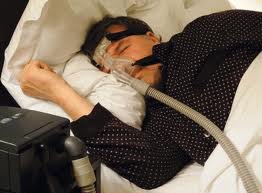
My niece would have liked to have added another lap before coming up for air but her body wouldn’t let her.  She needed to breath!  Have you seen the same thing happen in your spouse when they are sleeping?  They look like they are holding their breath doing laps and need to come up for air?  Gasp!  Ah!  Oxygen!  Sweet Oxygen!  Nothing like it.  This event when someone stops breathing for more than 10 seconds during sleep is called apnea.  When it happens more than 30 times in a night it is called Obstructive Sleep Apnea.  The gold standard for treatment is a machine that pushes air into the airway to keep it open – either bipap or cpap.

My patient is young, not obese, exercises regularly and looks healthy.  However, he has tested positive for Obstructive Sleep Apnea during a sleep study and has been prescribed cpap.  My patient used to wear it but frankly doesn’t feel sexy in it.  He feels like he’s wearing a jock-strap on his face.  My patient prefers to snore loudly, go silent, then gasp, over and over through his sleep rather than wear cpap.  No one had told my patient why he must wear cpap, nor did he look it up. We talked a little about his marriage and how he was happy at home.  We talked about school and how well he was performing.  Then we talked again about sleep apnea.  My patient didn’t know.  He didn’t know that he was gifting his wife with a future impotent man.  He didn’t know he was enjoying fewer an fewer functioning brain cells every day.  He didn’t know that he was gifting his children with his early death from heart attack.  He didn’t know that his anxiety might not be responding to his medications because his brain is screaming for oxygen.

Just thinking about his story made me take a deep breath and pray a prayer of gratitude for the air, oxygen, and life.  He did too.   We’ll see if he decides to use cpap or not over time.

In medicine, we can’t diagnose a primary emotional illness if someone has an ongoing medical disease that may be causing similar symptoms.  We need to be as sure as we can about where symptoms are coming from.  I liken it to a steam engine train chugging along, steam blowing out of the chimney.  The steam is what we see, but the onward movement of the train is the disease process.  Obstructive Sleep Apnea affects every cell, organ, system in our body because as it turns out, every bit of us needs oxygen to survive.  I’ve seen people after heart surgery, with no idea that they could have avoided all of that by simply using cpap.  I have been treating one woman now for 7 years for severe treatment resistant depression who is still not using cpap.

So many of the people I work with have sleep apnea.  They feel embarrassed and ashamed by it.  I’m not sure how to help them better but I’ll keep trying because their lives depend upon it.  To feel the sense of accomplishment my niece felt when she came up for air, “Ahhh!!”  Accepting treatment is that wonderful.  We could celebrate.  It’s all perspective.

Question:  Do you have any recommendations for those of us suffering and ashamed?

Self Care Tip #47 – Celebrate treatment and live.  Be a friend to yourself.

Look Around At The Other Reasons – Depression

Flagellants mortifying the flesh, at the time ...

Image via Wikipedia

“I’ve done some bad things.”  Patient tells me she can’t sleep well, is nauseated, depressed mood, worried with perseverating thoughts about acts that shame her and ramifications, doesn’t feel as much pleasure in life, isolating, tearful and more.  I was alarmed!  What could she have done that deserved this kind of self-flagellation?  When she told me, I didn’t realize it.

I was still waiting for the rest of the story.  I got caught up in her own self-judgment and found myself sitting beside her “in court.”  Once I realized what I was doing, I was chagrined.  Here I was collaborating with her in her inappropriate guilt.  It took me too long to register that her reaction was not proportionate to the offense.  I told her I was sorry she was going through all this emotion.  She said, “It’s my own fault.”  Is it though?  We needed to start looking at additional reasons that might be influencing the way she felt.

Start looking at other paradigms when the emotional response is out of proportion to the event(s).

An analytical approach would look at unconscious reasons, such as other personal choices that conflict with a core beliefs.  Or perhaps, something like unresolved anger coming out in physical and emotional symptoms. Ask about our “closets,” peel away pretense and let your flawed self into the air.  Keep it real.

Another paradigm is medical.  Inappropriate guilt is a symptom of Major Depressive Disorder, a debilitating disease process of the brain that affects the whole person/body systems.  When distorting things out of proportion, personalizing too much, we must ask if there is a depression going on.  Ask yourself.  Ask others.  But don’t let it continue if at all possible.  Major Depressive Disorder is a progressive disease that does more damage to the brain the longer it goes untreated.  In other words, the brain is affected more over time, it is harder to treat and it is more dangerous to the person.  The average length of an episode is 2 years and the more times it returns, the more chance to have the disease process continue for life.  Treating sooner and for longer, decreases the chance of relapse.

Excellent for us are the many treatment options for this potentially devastating disease.  Even in the “lifer,” when staying on medications, the relapses are much easier to get through and shorter in duration.  The medication has a protective effect on the brain.  Prophylactic against further insult.

In the woman I told you about, there was another emotional spectrum disorder, anxiety.  Anxiety and depression are like brother and sister.  They often go together.  But for today, we’ll leave it on the symptom of inappropriate guilt and let it rest on the reminder that the brain is human, mortal, attached to our neck and not an aura.  When the brain gets sick, it shows how it is doing the only ways it can, often through emotions.

Self Care Tip #46 – Look at all the reasons influencing the way we feel.  Be a friend to yourself.

Question:  What do you think?  Agree or disagree?  What is your story?